THE 3R FRAMEWORK
Respond. Reimagine. Retune.
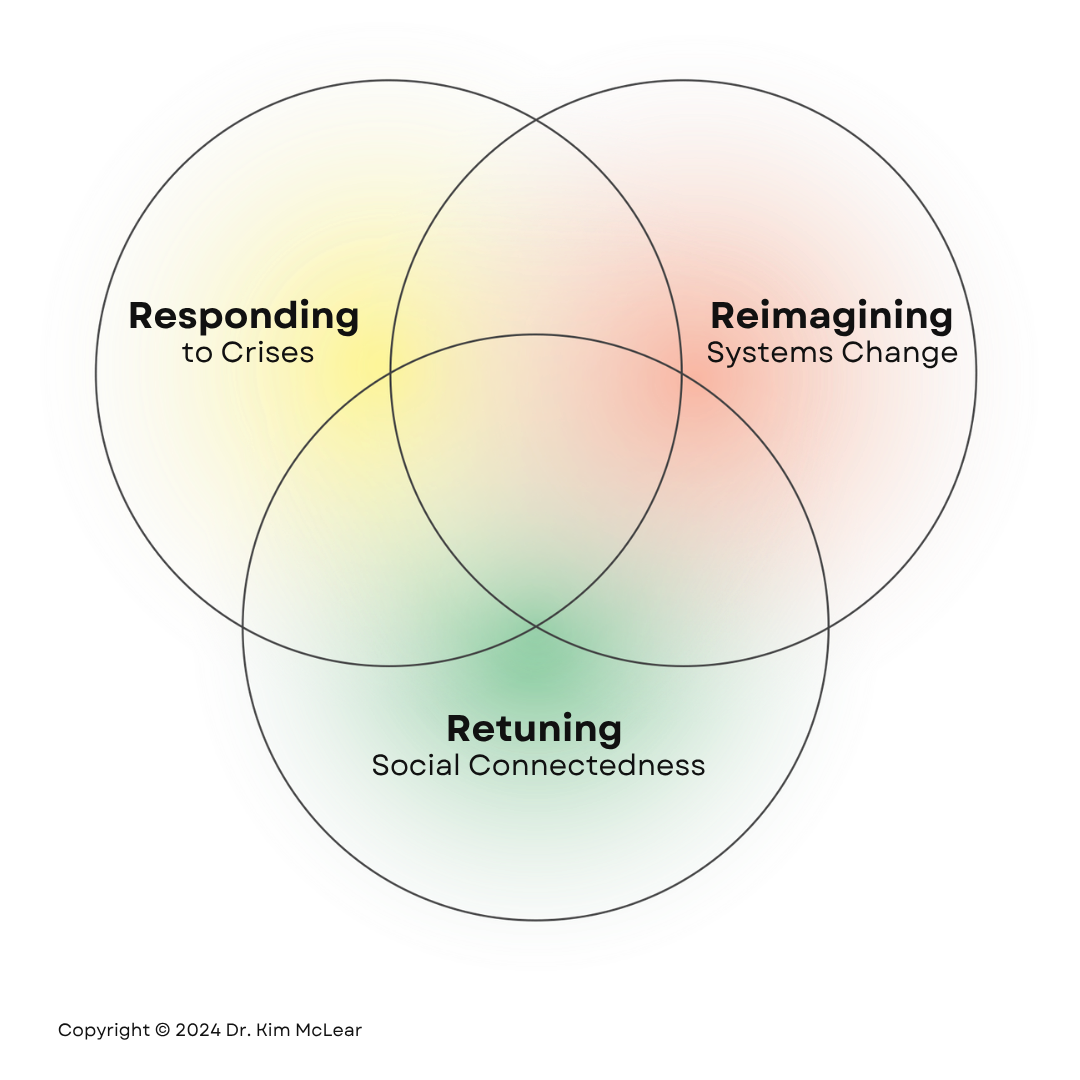
Civic futures asks us to work across three horizons at once: responding to what is fracturing, reimagining systems that no longer reproduce harm, and retuning relationships that enable people to take collective action.
The 3R Framework helps civic leaders, funders, and organizations hold these dimensions as one integrated practice.
The Art of Civics flourishes at this intersection.
-
Respond to Crises
Responding means recognizing urgent threats, protecting people and communities, and directing resources where they are needed now. It centers those closest to the harm while preserving dignity, participation, and community agency. Effective response should not merely stabilize a crisis. It should strengthen the relationships and capacities people will need after the immediate threat has passed.
Guiding question:
What must be protected, repaired, or resourced now, and whose knowledge should guide the response?Reimagine Systems Change
Reimagining systems change means questioning how transformation is understood, funded, and practiced. It examines who gets to define the problem, whose ideas count as credible, and whether familiar approaches reproduce the power structures they seek to change. It creates space for communities to shape strategies rooted in justice, pluralism, shared power, and long-term well-being.
Guiding question:
How must our understanding and practice of systems change evolve to create what current approaches cannot?Retune Social Connection
Retuning means strengthening the relationships, civic capacities, and patterns of participation through which people build trust, experience belonging, navigate difference, and act together. It treats pluralism as the capacity to share civic life without requiring sameness or avoiding conflict. Durable connection must include agency, accountability, reciprocity, and the power to shape collective decisions.
Guiding question:
What relationships and civic capacities must be strengthened so people can navigate difference and sustain change together? -
The Art of Civics is the practice of bringing all three dimensions together.
It is responding to what is breaking without accepting crisis as permanent.
It is reimagining what could replace harmful systems without becoming disconnected from people’s present realities.
It is retuning social connection so that communities can build trust, navigate disagreement, exercise civic agency, and sustain collective action across difference.
At their intersection, civic culture becomes more than a collection of attitudes or individual behaviors. It becomes a living infrastructure of relationships, practices, stories, institutions, and forms of participation that help people shape their common life.
Durable civic change requires all three:
Response without reimagination manages recurring harm.
Reimagination without relationship struggles to become real.
Connection without power or agency cannot produce lasting change.
The Art of Civics holds immediate needs, structural transformation, and relational capacity together.
-
The 3R Framework can support philanthropic strategy, organizational learning, civic program design, community convenings, grantmaking, and systems-change initiatives.
It can help leaders examine not only what they support, but how their own practices influence civic culture: whose knowledge is valued, how power is shared, how disagreement is held, how relationships are sustained, and whether communities leave the work with greater capacity and agency.
Respond
Whose understanding of the crisis is shaping the response?
Who is already protecting, organizing, or holding the community together?
Are resources moving at the speed of the need?
Does the response protect people’s dignity and civic agency?
What relationships and capacities will remain when emergency support ends?
Reimagine
Are we improving the existing system or making meaningful alternatives possible?
Whose imagination is being treated as credible and worthy of investment?
Which assumptions about expertise, evidence, scale, risk, or power need to be reconsidered?
Are affected communities participating in decisions or merely being consulted?
What would become possible if communities had greater control over resources and institutions?
Retune
Does the work strengthen trust, belonging, civic agency, and collective capacity?
Can people engage real differences without erasing conflict or unequal power?
Which relationships have been damaged, excluded, or taken for granted?
Are communities being asked to collaborate without acknowledging histories of harm?
How will reciprocity, accountability, productive disagreement, and joy be cultivated over time?
Does the work leave people better able to act together after the formal initiative ends?
-
Philanthropy shapes civic culture not only through what it funds, but through how it listens, convenes, measures, communicates, shares power, and remains accountable to communities.
The 3R Framework helps funders consider whether a strategy:
responds effectively to current threats and community needs;
expands the possibility of structural and institutional change;
strengthens pluralism, social cohesion, and civic participation;
increases community agency rather than dependency;
supports the relationships required for long-term well-being;
and builds durable civic capacity beyond the life of an individual grant.
The framework can be used to assess portfolios, structure learning communities, design funding strategies, guide grantee conversations, and identify dimensions of civic culture that may be missing from an initiative.
-
The 3R Framework is an evolving civic-learning tool created by The Art of Civics Project.
We use it to help leaders and organizations see where their strategies are strong, where essential dimensions are missing, and what becomes possible when crisis response, systemic imagination, pluralism, and social connection move together.
Respond to what is breaking.
Reimagine what could be.
Retune how we live and act together.